Feegrade And Co Private Limited
Versus
Commissioner Of Customs
Customs Appeal No. 20970 of 2015 decided on 17-10-2025
CUSTOMS, EXCISE AND SERVICE TAX
APPELLATE TRIBUNAL
HYDERABAD
REGIONAL BENCH - COURT NO. – I
Customs Appeal No. 20970 of 2015
(Arising out of Order-in-Appeal No. 117 & 118/2014 - VCH dated 16.09.2014 passed by Commissioner of Customs, Central Excise and Service Tax (Appeals), Visakhapatnam)
M/s Feegrade And Co Pvt Ltd.,
.. APPELLANT
Rungta House, Chaibasa Po,
Jharkhand – 833 201.
VERSUS
Commissioner Of Customs
.. RESPONDENT
Visakhapatnam - Customs
4th Floor, Customs House,
Port Area, Visakhapatnam,
Andhra Pradesh – 530 035.
WITH
Customs Appeal No. 20601 of 2015
(Arising out of Order-in-Appeal No. 180/2014 - 15 - VCH dated 19.01.2015 passed by Commissioner of Customs, Central Excise and Service Tax (Appeals), Visakhapatnam)
M/s Feegrade And Co Pvt Ltd.,
.. APPELLANT
Rungta House, Chaibasa Po,
Jharkhand – 833 201.
VERSUS
Commissioner Of Customs
.. RESPONDENT
Visakhapatnam - Customs
4th Floor, Customs House,
Port Area, Visakhapatnam,
Andhra Pradesh – 530 035.
WITH
Customs Appeal No. 20602 of 2015
(Arising out of Order-in-Appeal No. 181/2014 – 15- VCH dated 19.01.2015 passed by Commissioner of Customs, Central Excise and Service Tax (Appeals), Visakhapatnam)
M/s Feegrade And Co Pvt Ltd.,
.. APPELLANT
Rungta House, Chaibasa Po,
Jharkhand – 833 201.
VERSUS
Commissioner Of Customs
.. RESPONDENT
Visakhapatnam - Customs
4th Floor, Customs House,
Port Area, Visakhapatnam,
Andhra Pradesh – 530 035.
AND
Customs Appeal No. 20603 of 2015
(Arising out of Order-in-Appeal No. 182/2014 – 15 - VCH dated 19.01.2015 passed by Commissioner of Customs, Central Excise and Service Tax (Appeals), Visakhapatnam)
M/s Feegrade And Co Pvt Ltd.,
.. APPELLANT
Rungta House, Chaibasa Po,
Jharkhand – 833 201.
VERSUS
Commissioner Of Customs
.. RESPONDENT
Visakhapatnam - Customs
4th Floor, Customs House,
Port Area, Visakhapatnam,
Andhra Pradesh – 530 035.
APPEARANCE:
Shri S.C. Choudhury, Advocate for the Appellants.
Shri K. Sreenivasa Reddy, Authorised Representative for the Respondent.
CORAM: HON’BLE Mr. A.K.
JYOTISHI, MEMBER (TECHNICAL)
HON’BLE Mr. ANGAD PRASAD, MEMBER (JUDICIAL)
FINAL ORDER No. A/30427-30430/2025
Date of Hearing:03.07.2025
Date of Decision:17.10.2025
[ORDER PER: A.K. JYOTISHI]
M/s Feegrade And Co Private
Limited (hereinafter referred to as Appellant) are in appeal against the
Order-In-Appeal No. 117 & 118/2014 dated 16.09.2014, 180-182/2014-15 dated
19.01.2015 (impugned order).
2. The issue, in brief, is that the appellant had entered into contract with
foreign buyers for supply of Iron Ore of certain specifications, where the final
price was payable depending on the actual quantity received, quality, actual Fe
percentage determined as per CIQ report at the discharge Port, in terms of
mutually agreed terms and conditions. The final payment was based on final
commercial invoice to be issued by the appellant in terms of finally determined
quality, quantity etc., in accordance with the contract. The Department, at the
time of export, kept the assessment provisional based on provisional invoice
furnished by the appellant as also for the purpose of testing certain para-meters
like moisture content and Fe percentage. For the purpose of provisional
assessment, necessary bond and security as directed by the Department was also
executed by the appellant. Subsequently, based on the test report of CIQ at the
discharge port and on receipt of final payment based on final commercial invoice
issue by the appellant to the foreign buyers, the appellant approached the
Department for finalization of their provisional assessment.
3. The Department, in general, calculated the net quantity of export taking into
account the moisture content, as determined by their lab i.e. CRCL, based on
sample taken at the time of export and thereafter proceeded to examine the final
invoice and proof of receipt of payment in the form of Bank Realisation
Certificate (BRC). While re-determining the value, they did not dispute the rate
per Metric Tonne of ore, as declared, at the time of export but re-computed the
total export quantity itself keeping in view the moisture content determined by
the CRCL, which was lower than the declared moisture content at the time of
export or even lower to moisture content shown in the CIQ report at discharge
Port. Since, the appellant had paid duty provisionally and also deposited
certain additional amount as directed by the Department based on provisional
invoice at the time of provisional assessment, they approached for refund of
excess payment in terms of the statutory provisions. Based on their assessment,
Department re-worked out the total duty payable and amount already paid to
compute the amount of refund admissible. It is the grievance of the appellant
that the said refund amount has been wrongly computed in as much as while
recomputing the same, they had not taken note of the fact that there was no
occasion for the department to doubt the transaction value in the first place or
BRC and therefore BRC value or realised value for the consignment should have
been taken as the basis for deciding the final duty payable and it was not open
to them to re-compute the entire duty liability in the manner in which they have
re-computed the refund amount by re-determining the quantity of export leading
to grant of lesser refund than what they are otherwise eligible for.
4. Learned Counsel for the appellant has mainly submitted that it is not
disputed that the entire consignment has been exported in terms of contract
between the appellant and the importer abroad. It is also not disputed that they
have realised only the sum as reflected in their final invoices as well as BRC
from their buyer, who is not a related person. It is also not disputed that the
transaction value declared by them in terms of per Metric Tonne of ore at the
time of export has been found correct or not acceptable to the Department.
Therefore, when there was no reason to doubt the transaction value, the
Department could not have again re-computed the value for the purpose of
computing customs duty payable by resorting to Rule 4 and 5 of Export Valuation
Rules. It was already pointed out that no grounds were adduced or any
opportunity given before re-computation clarifying as to what was the ground on
which the transaction value was not found admissible. He further submits that
the variation in quantity due to moisture content is of no consequence post
10.10.2007, as old Section 14 covering the valuation of goods for import and
export has been rescinded with a new concept of transaction value, wherein,
there is a specific provision as to under what circumstances, a transaction
value can be rejected and the value for the purpose of payment of customs duty
could be re-computed and in what manner. One of the major criteria is to explain
the reasons as to the ground for doubting the declared transaction value, as
also the rationale and basis for adopting a particular method under Rule 4 or 5
for re-computing the value. Further, when duty is payable on advalorem basis,
redetermination of quantity is not required and the final value received towards
the consignment from buyer has to be taken as the transaction value. He has also
relied on many case laws, including in their own case, decided by this Bench. He
is relying on the case of VGM Exports vide Final Order No. A/30317-30324/2024
dated 06.05.2024. He is further submitting that during the export, they had
deposited 20% of duty, as additional revenue deposited, to cover any excess duty
payment that may become payable on account of finalisation of assessment and
since it was a provisional assessment, such deposits were not in the nature of
duty and only a revenue deposit and in view of the same, they are also entitled
to get interest. He has relied on certain case laws viz - Indore Treasure Market
City Pvt. Ltd., VS Commissioner of CGST and Central Excise, Indore vide Final
Order No. 50125 of 2024 dated 11.01.2024 [2024 (24) Centax 469 (TriBang)] and
Parle Agro Pvt Ltd., Vs Commissioner, CGST, Noida [2022 (380) ELT 219 (Tri-All)]
as also the Co-ordinate Bench decision in appeal no. C/75029/2020 vide Final
Order No. 76970/2024 dated 09.09.2024.
5. Learned AR on the other hand has mainly submitted that the Adjudicating
Authority has rightly accepted the CRCL report for the purpose of determining
moisture content in the exported goods and accordingly recomputed the value of
the consignment.
6. Heard both the sides and perused the records.
7. Since in all these appeals, the issues are more or less similar and impugned
Order-in-Originals and Order-in-Appeals have also analysed and decided the
matter more or less on similar lines and also the terms of contract being more
or less similar, we proceed to decide all these appeals by way of common order.
8. However, before we proceed, some of the admitted factual positions in these
appeals, which has not been disputed, need to be highlighted. The transaction
value per Metric Tonne, as declared at the time of export, has not been doubted
by Department. It is a case of provisional assessment where provisional duty and
certain additional amount was paid at the time of export on provisional basis.
There is some dispute as regards the coverage and liability on account of
execution of bond, wherein the Department feels that it was incumbent upon
appellant to accept the CRCL moisture report in terms of said bond, whereas, the
appellant’s submission is that the bond was only binding on them to pay the
differential duty, if any, after finalisation of provisional assessment, and
that the CRCL test report in respect of moisture content was relevant only to
the extent to determine the Fe content, as more than 64% Fe content would have
covered the consignment under the restricted category, as iron ore above 64% Fe
content was a canalised item. Therefore, there is no binding on them in terms of
said bond to accept moisture content as determined by CRCL for the purpose of
re-determining the quantity of goods exported.
9. We have perused the relevant contracts covering the exports under different
Shipping Bills, where same standard terms and conditions regarding quality,
price adjustment for Fe content, bonus / penalty for impurities, payment
methods, method of sampling and analyse etc., have been agreed upon. It also,
interalia, provides that the weight as determined by the CIQ shall be final and
clause 9(a), para 3 of contract further provides that CIQ analysis (for moisture
and composition) shall be final. Therefore, what is to be understood that while
the price declared at the time export was provisional and was dependent on the
mutually agreed terms and conditions between the exporter / appellant and the
importer in foreign country after it’s analysis at the time of unloading at
discharge Port by designated agency (CIQ). We find that Commissioner (Appeals)
has gone through each of the parameters declared by the appellant provisionally
and the ones adopted by the Adjudicating Authority for computing the total duty
payable at the time of finalisation of Shipping Bills. The same is reproduced
below for ease of reference:
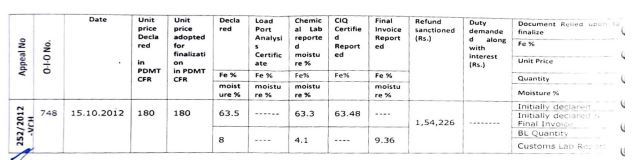
Further, in order to understand the method of computing the duty payable by the
Department, we have also gone through the calculation sheet adopted by the
Refund Sanctioning Authority for deciding the refund amount on conclusion of
finalisation of Bill of Entry. We have taken up Order-in-Original No. 748/2012
dated 15.10.2012, which is the subject matter of Order-in-Appeal No. 181/2014
and covered in appeal no. C/20602/2015 as a reference case. The computation is
indicated below for ease of reference:like image
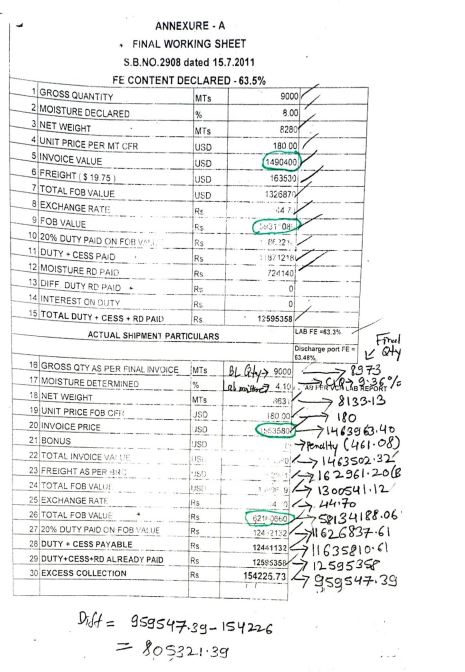
From the perusal of the above, it is obvious that there is not much dispute
regarding the Fe content of iron ore fines, as declared or as found in terms of
CRCL report or for that matter in terms of final invoice, as thus treated as
within the tolerance. The Department has also not contested the slight variation
in percentage of Fe content as determined by CIQ. They have also not disputed
unit price per Metric Tonne as declared at the time of export in the final
invoice, being same. The Adjudicating Authority has, however, taken for the
purpose of computation, the moisture content as determined by the CRCL and has
ignored the moisture content as per CIQ report. There is no dispute in so far as
unit price, however, the dispute is on account of the net weight i.e 8631 MT
arrived at by the Adjudicating Authority as per moisture content declared by the
CRCL i.e 4.10% whereas, the net quantity in terms of contract has been decided
as 8133.13 MT taking into account the CIQ’s determination of moisture 9.36%.
Therefore, it is apparent that based on this method of computation, the
Department arrived at a higher FOB value, as compared to lower FOB value which
was taken by the appellant for the purpose of raising final commercial invoice
as per terms and conditions of contract and as a consequence, the excess payment
computed was determined by the Adjudicating Authority as only Rs. 1,54,226/-
whereas, as per the appellant it should have been Rs. 9,59,547.39 and therefore
they have been deprived of refund of Rs. 8,05,321.39/-.
10. We find that essentially it is a case where the contract for supply of iron
ore has certain parameters as regards Fe content, moisture content etc., and has
also prescribed certain tolerance for the same. It has also prescribed for
certain bonus and penalty in the event of those parameters being met or not met.
It has also provided for payment, both provisional and final, and basis for
arriving at the final price. Therefore, it is obvious that once there is a
contract, which is dependent on determination of the net quantity and certain
quality parameters in a manner understood to both exporter and importer, the
final invoice has to be raised in accordance with the agreed upon terms and
conditions and accordingly a final invoice has been raised in this case also and
the payments have been received to that extent only as evidenced by the BRC,
which is a document which indicates the realisation in terms of particular
export consignment under the cover of a particular shipping bill(s). This
document, per se, has not been doubted. We also note that in any case, the
re-computation of the quantity has got no meaning when the duty itself is on
advalorem basis and therefore what is important is to see whether there was any
ground for doubting the declared transaction value in the first place or
otherwise. In this case, no grounds were existing at the time of declaration, as
obviously neither Department nor the appellant were sure about what would be the
final price in terms of the negotiated, mutually agreed contract covering the
said consignment. It was at the time of finalisation of provisional assessment,
when the final invoice and the BRC were submitted to the Department, they could
have raised any objection as regards non-acceptance of the said transaction
value or BRC and thereafter they could have proceeded as provided under the
Export Valuation Rules following certain prescribed procedure and thereafter
could have adopted the value of either identical goods or similar goods. We find
that no such activities have been undertaken, and finalisation is based & relied
on re-computation of quantity based on the moisture content as determined by the
CRCL. We find much force in the submissions of the appellant that in terms of
contract, the quantity has to be determined in terms of the moisture content
adopted by the importer in terms of CIQ. Moreover, we also find that when the
export duty is leviable on ad valorem basis, the re-computation of the quantity
based on the moisture content has no meaning, as has been held in their own case
in the Appeal No. 25373/2013 by this Bench. We have perused the judgment passed
by the Hyderabad Bench in the bunch of appeals, vide Final Order No.
A/3031730324/2024 dated 21.06.2024, wherein, interalia, all these issues were
deliberated upon and it was, interalia, held that irrespective of the quantity
of ore exported, as the export duty is on ad valorem basis, the value for export
duty has to be taken as per transaction value only. It was held that in all such
cases, transaction value has been followed by the appellant including present
appellant. The relevant paras are cited below:
11. Therefore, in all these cases, the contracts are clearly specifying these parameters. From the documentary evidence provided by way of invoices, it is seen that based on the moisture content arrived at by CIQ, the appellant has reduced the quantity and arrived at the DMT quantity. There is no dispute that the appellant has realised only the value shown in the total value shown in the invoices. Therefore, it is clear that the transaction value has been followed by the appellant. This also meets the requirement as specified in the Circular No. 12/2014 dated 17.11.2014. Hence on this count the Appeal stands allowed.
12. Another point to be considered is that in this case the Export duty is on advalorem basis, which is dependent on the value of the consignment exported. Irrespective of the quantity of DMT exported, the fact remains that the appellant has received the export proceeds only for the net quantity shown in their Invoices. Hence, the value for Export Duty has to be taken as per Transaction Value only. Admittedly, as per the Para 11 of the Order-in-Original, the transaction value is not doubted. Hence, even on considering this fact, the impugned order cannot be sustained.
11. We, therefore, find that the
issue of modifying or re-determining the quantity in final invoice based on
moisture content as per CIQ report, has been followed consistently, especially
when the amount received is in accordance with the said quantity in terms of the
contract. We also note that great deal of emphasis has been placed on Bond
executed by the appellant at the time of provisional assessment. We find that
the bond is primarily for binding exporter to pay the differential duty, if any,
on final assessment of duty and not for accepting moisture content of CRCL.
Therefore, bond and any additional security provided by exporter is essentially
for binding him to ultimately pay the amount finally determined but it cannot be
construed that it binds exporter irrevocably to accept even the parameters like
moisture content as determined by CRCL having bearing on quality and quantity
etc., which is contrary to mutually agreed contract unless specifically covered
in the said bond in explicit manner. If that is the case, everything could have
been determined at the time of export itself based on parameters determined by
CRCL itself and therefore there would not have been any reason to resort to
provisional assessment. We feel that at most, the bond could have covered Fe
Content determination and if found above 64% it would have made the said export
restricted and liable to certain final action. That is not the case here. We
have also perused the judgment relied upon by Learned AR, M/s Aban Loyd Chiles
Offshore Ltd., Vs Union of India [2008 (227) ELT 24 (SC)] and Reliance Cellulose
Products Ltd., [1997 (93) ELT 646 (SC)]. The context and facts analysed and
observations made are not relevant to facts of the case as in the present
appeal, there is a contract which regulates the final price, hence full effect
has to be given to that contract. Therefore, the facts are distinguished. We
find that in the present appeals facts are more or less similar to earlier
decided matter in their own case and therefore following the ratio laid down in
their own case, we find that the order of the Commissioner (Appeals) upholding
the order of the Adjudicating Authority is not legally tenable and therefore
liable to be set aside.
12. The appellants have also requested that since they had deposited 20% of the
duty based on the declared value, as additional revenue deposit, to cover any
excess duty at the time of provisional assessment and therefore, said deposits
are in the nature of revenue deposits and therefore in the event of not getting
adjusted against the final payment of duty, the same is required to be refunded
along with interest, relying on certain judgements cited, supra. We find that
Section 18 of the Customs Act regulates the entire gamut of provisional
assessment of duty, including requirement to pay the additional duty, in case
finally assessed duty is higher than the amount deposited or return the amount
by way of refund, in case it held to be more than duty finally assessed.
Essentially, the provision is that when an assessment is done provisionally in
terms of Section 18, the exporter is required to furnish certain security, as
the proper Officer may deem fit, for the payment of deficiency, if any, between
the duty as may be finally assessed or re-assessed as the case may be and the
duty provisionally assessed. Thereafter, when the duty leviable on such goods is
assessed finally, then the amount paid towards the deficiency between the duty
provisionally assessed and finally assessed is required to be adjusted against
the duty finally assessed first and thereafter, if some amount of duty is still
required to be recovered then the exporter is required to pay by adjusting the
amount already paid, whereas, if the amount paid is in excess of duty finally
assessed, then the said amount will be refunded. Further, Section 18(4)
provides, subject to sub-section 5, that if any refundable amount referred to in
clause (a) of sub-section 2 of Section 18 is not refunded under that sub-section
within three months from the date of final assessment of duty finally, they
shall be paid interest on such un-refunded amount at such rate fixed by the
Central Government under Section 27(1) till the date of refund of such amount.
Therefore, the harmonious reading of the provisions under Section 18 would
indicate that it is a comprehensive provision to regulate as to how provisional
assessments are to be regulated. Therefore, whatever amount is paid as an
additional deposit or security at the time of provisional assessment are in the
nature of security or revenue deposit, which is required to be adjusted or
appreciated towards duty in case any deficiency is noted between the duty paid
at the time of provisional assessment and duty finally assessed. Therefore, it
is not in the nature of duty, per se. Further, this amount has not been referred
to as duty in Section 18 of the Customs Act itself and it has been referred to
as an “amount” and the refund is also required to be made in respect of the said
amount and that to within three months from the date of finalisation of the
provisional assessment. Therefore, in a situation, where, on finalisation of
provisional assessment excess payment do not get fully adjusted towards duty
payable and there being excess would be entitled to be refunded in terms of
Section 18(4) and would also be entitled for interest, as prescribed in this
regard, beyond three months from the date of finalisation of provisional
assessment. Thus, interest is also regulated by the Section 18(4) and there is
no need to provide any other method for determination of interest amount. We
also find force in the judgments cited by Learned Advocate in support of
entitlement of interest in respect of such excess payment.
13. Therefore, having regard to the various citations, as well as statutory
provision, we find that the amount of customs duty finally payable has to be
computed by the Refund Sanctioning Authority, based on the value/price received
by the appellant in terms of final commercial price and BRC and thereafter,
excess payments of any amount, if any, made by them has to be computed and
refunded along with applicable interest in accordance with the provisions under
Section 18(4) of Customs Act 1962. Further, this being an old matter, the
exercise to re-compute and grant of refund and interest thereon in accordance
with law has to be concluded within a period of two months by the Department
subject to appellant providing the relevant documents. The matter is remanded
back only for the re-quantification of refund and applicable interest in view of
observations made in earlier paragraphs.
14. Appeals are allowed by way remand with consequential reliefs, as per law.
(Pronounced in open court on 17.10.2025)
(A.K. JYOTISHI)
MEMBER (TECHNICAL)
(ANGAD PRASAD)
MEMBER (JUDICIAL)